One of the easiest and most enjoyable ways to explore your passion for a subject beyond the curriculum is to read about it. This doesn't have to just be academic textbooks - there are also loads of great, fun and informative magazines and popular science books out there. Although most of the books below are aimed at AS or A level students, since these are the most familiar books to me, I will aim to review a few for other ability levels as well. If you have any suggestions for books or want to write a review yourself - please do get in contact using the 'contact us' box.
If you buy a lot of books or travel frequently, I would highly recommend purchasing a Kindle paperwhite e-reader or similar. The books tend to be significantly cheaper and you can carry your whole collection around with you!
Showing posts with label 7 Books. Show all posts
Showing posts with label 7 Books. Show all posts
Cox & Forshaw: Why does E=mc^2
Authors: Brian Cox and Jeff Forshaw
Subject(s): Physics
Rating: 5/5
Minimum ability level: AS
Buy now on Amazon.
This is a really great book which explores Einstein's theory of relativity in a much easier to understand way. Keeping equations to a minimum and using no more than GCSE level (or below) maths along with excellent diagrams and explanations, this book should be easily accessible to most students.
The book also describes how this famous equation relates to our everyday lives - for example how the sun releases its energy and why nuclear power is so efficient.
I included this book in my personal statement and compared it with Einstein's original text - I would highly recommend reading both books, since although 'Why does E=mc^2' is easier to read and understand, Einstein gives a more formal and in depth derivation which is definitely worth a look if you are particularly interested in the 'proof' of the equation and can cope with the slightly old-fashioned language and context.

Du Sautoy: The Music of the Primes
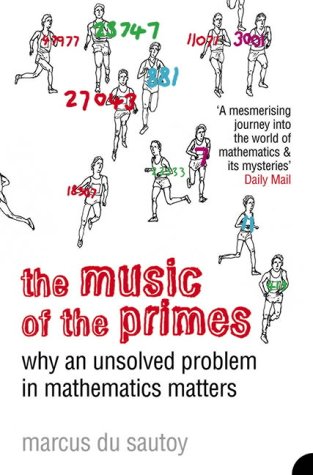 Author: Marcus Du Sautoy
Subjects(s): Maths
Rating: 5/5
Minimum Ability Level: AS
Buy now on Amazon.
This is a fascinating book about prime numbers, revealing just how little we actually understand about them and yet how crucial they are to our everyday lives - from computing and encryption to chaos theory and quantum mechanics. The main topic of the book is the Riemann Hypothesis - which is proved would win the mathematician a million pounds from the clay Institute! Du Sautoy explores the discovery and subsequent attempted proofs of the hypothesis from a historical perspective, as well as giving very clear and simple explanations to guide the reader through one of the most challenging topics in modern mathematics. I would highly recommend it to anyone interested in studying maths!
Kaku: The Physics of the Impossible
Author: Michio Kaku
Subject(s): Physics
Minimum Ability Level: Secondary School
Rating: 4/5
Buy now on Amazon.
Kaku has written a great book discussing the physics behind popular science fiction topics such as teleportation and parallel universes - categorising them into three groups: Class 1 (topics which do not do not violate the laws of physics), Class 2 (ideas on the boundary of our understanding of physics) and Class 3 (impossible according to our current understanding of physics). Although all of the topics discussed are not currently possible, at least not in the way we understand them from science fiction, Kaku discusses some of the advancements in each field as well as the history and evidence of each. It makes a fascinating read, and is a great starting book to discover some interesting topics for further reading - particularly since in the 5 years since the book has been read there have been some exciting developments in some of the 'impossible' topics discussed!
Dawkins: The Selfish Gene

Subject(s): Biology, Chemistry, Genetics, Evolution
Minimum Ability Level: AS
Rating: 5/5
Rating: 5/5
Buy now on Amazon.
This is a really great book which describes evolution in terms of individual genes - small, self-replicating molecules competing in an environment of limited atoms - and how they build 'gene machines' (i.e. us!) to improve their chance of replicating. He continues to explore how so-called selfish genes explain natural phenomena such as suicidal bees, by discussing mathematically using game theory how this apparent altruism benefits the gene by improving the chance of related organisms surviving. He also explains subjects such as the energetically expensive and dangerously bright colours of male birds using similarly easy to follow arguments. This book gave me a great insight into genetics and evolution, and would be suitable for any AS student considering studying a related subject at university.
Subscribe to:
Posts (Atom)